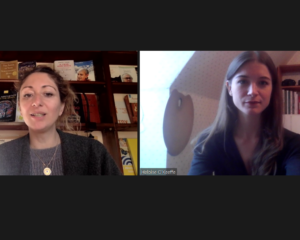
A talk by Kate Enters – Director & Founder of ArtCan
Presented at Platforms Project 2026 – Athens
Firstly I need to caveat my talk with a statement. The thoughts and explorations I am about to share come from my personal experience and observations as the founder of an artists collective. I have a very clear and humble awareness that there are no simple or quick solutions – and definitely no “one size fits all” formulas available – and nor should there be. Instead I hope that by sharing this talk with you, and within it you recognise some of the scenarios, themes, and observations we leave feeling ‘seen’ and perhaps a little closer together as we navigate the challenging world as creatives and collectively our creative voice feels a little stronger.
So… ArtCan… ArtCan began 14 years ago as a single group exhibition. It organically and beautifully grew over the years to what is now, an international, entirely volunteer run, non-profit organisation that offers contemporary artists opportunities to exhibit, connect and progress their practice without reliance on formal gallery structures. We are over 500 artists now across 26 countries with our headquarters in the UK.
My talk is titled: The Question of Visibility for contemporary artists in today’s society… And I want to begin with a question that sits at the heart of ArtCan’s work: what does it really mean for an artist to be visible today?
Visibility can sound simple, even desirable. We associate it with opportunity, recognition, reach and success. But for artists, visibility is never just about being seen. It is about being understood, supported, contextualised and valued.
When I delivered that first exhibition 14 years ago, I realised I was responding to a gap within society for artists: the divide between the quality of work artists were making and the support available to them once they were outside art school, outside traditional representation, or outside the established networks that so often determine who is noticed. Many artists were deeply committed, thoughtful and ambitious, yet they were working in isolation. They had the talent, but not always the access, the confidence, the platform or the professional structure or tools to help that talent become sustainable.
ArtCan was therefore able to bridge that space. It was never simply about putting artists in front of an audience. It was about creating something practical, professional and human: a network, a platform and a community that could help artists feel less alone, more connected, and more able to navigate the complex realities of contemporary practice. Something very real – allowing individuality amongst the wider collective energy
of the group.
To speak about the artist’s position in contemporary society is to speak about contradiction. Artists are asked to be experimental and entrepreneurial, reflective and productive, independent and collaborative, visible and authentic. They are expected to, and do, contribute hugely to cultural life, community, education, wellbeing, place-making and critical debate, yet the structures around them do not always recognise the labour, vulnerability and persistence involved in providing and sustaining that ‘gift’ to society – and the word ‘gift’ is not used lightly in this context.
As this is where the question of visibility becomes more complicated. Visibility can open doors, but it can also become a pressure. Artists may feel that they must constantly present, promote and perform their practice in order to remain relevant. Digital platforms have widened access in many ways, but they have also created a crowded and fast-moving environment in which being seen does not necessarily mean being remembered,
understood, paid or provide a longevity of support.
For ArtCan, visibility must therefore be meaningful. It is not enough to offer exposure for its own sake. Artists cannot live on visibility alone, however flattering the wording might be. A genuinely valuable opportunity needs, at its core, sustainable and reassuring longevity and care as well as an opportunity for sales and financial stability. There is a luxury and naiveness in providing a platform purely for showcasing artists without giving
some attention to possible sales or collectors – that decision itself becomes an elitist enterprise. In today’s society – whilst beautiful to remove the expectation of sales, and how wonderful if we didn’t have to ‘sell’ art as an artist, we should not forget that the majority of artists need this financial return to take the next step forward within their practice. Taking out the obvious commercial impact of a sale, we should never underestimate the emotional and mental positivity this process offers to an artist as well.
The artist’s journey is often described as an individual path, and in many ways it is, and in many ways it is a beautiful beautiful thing that should always be encouraged and nurtured. Every practice has its own rhythm, language, references and evolution. But no artist develops in a vacuum. A sustainable artistic journey needs conversation, feedback, challenge, encouragement and the chance to be placed in relation to others – not for
validity or for judgement or contrast, but for positioning within the wider jigsaw that is our society and life. Community is not a soft extra; it is part of the infrastructure that allows artists to keep going.
That is why community has always been central to ArtCan. As the organisation has grown the challenge has been to make growth feel personal rather than anonymous. Artists do not need to feel as though they have joined a mailing list with ambitions. They need real points of connection: exhibitions, mentoring, conversations, partnerships, shared opportunities and ongoing communication.
ArtCan sits between artist support, curation and platform-building. Those roles are not separate; they are deeply connected. Artist support is the foundation, because without it, curation can become surface without substance. But support also needs to lead somewhere and inspire longevity of vision.
In shaping ArtCan’s direction, the essential question is always the same: how does this genuinely serve artists? Sometimes the answer is an exhibition. Sometimes it is a collaboration, an art fair, a digital platform, virtual exhibition opportunities, editorial visibility, mentoring, advocacy, opportunity for curation, or the quieter work of making introductions and sharing knowledge. The form may change, but the purpose remains
consistent: to keep artists at the centre.
If visibility is to be meaningful, it must be connected to sustainability. Too often, artists are expected to absorb enormous financial, emotional and practical pressure simply to remain active. That expectation is not only exhausting; it excludes too many people from the possibility of a long-term creative life.
We need a broader shift in how artists’ labour is understood and valued. That means fairer funding, more transparent opportunities, affordable workspaces, and a stronger commitment and structure to paying artists properly for their time and expertise. It also means widening our idea of success. There is no single model for a sustainable artistic career, fluidity and flexibility is core for an artist to be allowed time for exploration, play
and that moment of genius that truly illuminates what and who it reaches so positively.
As the art world becomes more global and digital, I believe that organisations like ArtCan have an increasingly important role to play. Technology can extend reach, and I love technology, but it cannot replace trust, context or human connection. The future is not simply about being online; it is about building meaningful structures within that space so artists are not just visible for a moment, but supported continuously.
So perhaps the question of visibility is not simply, “How do artists get seen?” It is, “What kind of visibility allows artists to thrive ?” Visibility should not be a brief spotlight that leaves the artist exposed. It should be part of a wider ecology of support: a way of connecting artists to audiences, peers, opportunities, resources and recognition. And this needs to reach outside of the ‘perceived art world’ – crossing into all areas of society and
business.
ArtCan exists because artists need more than encouragement. They need access, community and structures that understand the realities of creative practice. In contemporary society, where image, speed and attention often dominate, we have to keep asking what it means to truly see an artist — not only the finished work, but the labour, journey, resilience and possibility behind it.
That, for me, is the real question of visibility: how we create the conditions in which artists are not only looked at, but listened to; not only showcased, but sustained; not only present, but able to keep making work that challenges, connects and matters. It already exists across huge swathes of the world—in studios, communities, temporary spaces, online networks and informal collaborations—but it is not yet enhanced, supported or, dare
I say, celebrated enough to become the truly strong universal language and energy that this world so desperately needs.
To reach that point, visibility must be treated as a shared responsibility rather than a burden placed solely on the artist. Cultural organisations, funders, businesses, educational institutions, audiences and fellow artists all have a role in creating routes that are sustained beyond a single exhibition, post or moment of attention. When artists are given time, fair resources, meaningful dialogue and the freedom to take creative risks, their
work can move beyond individual recognition and contribute to a richer cultural life – one that strengthens communities, opens new ways of thinking and reminds us of our capacity to imagine differently. And that is where the magic happens!
It’s an ongoing navigation – trying to find that magic, but we should never underestimate the power of connectivity, united voices and visuals – especially those that are universal and need no translation. I am lucky as I have first-hand experience of how creatives are stronger, more confident and generous when feeling connected – which creates a beautiful ripple effect that is a vital vein of society – I am proud that this is the core of what ArtCan is, and this strength gives it huge potential to grow upon.